Rui (Ray) Ding
AI × complex functional materials / devices
click to sample
tap to sample
drag to orbit · scroll to zoom
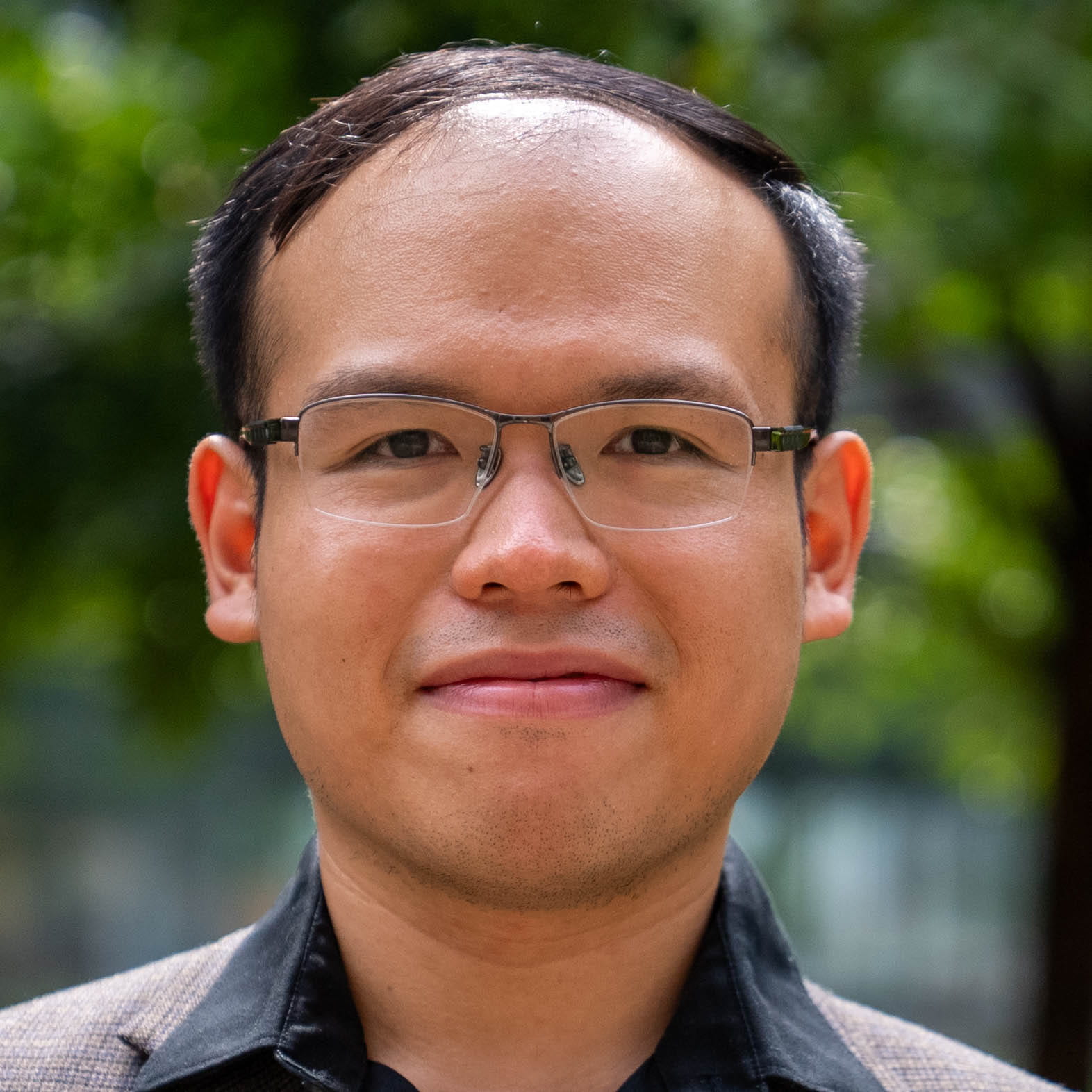
Rui (Ray) Ding
Schmidt AI in Science Fellow
University of Chicago & Argonne National Laboratory
I build AI co-scientist systems for complex materials and device discovery in the data-scarce, unbenchmarked regime. Autonomy here is a decision problem before it is a robotics problem: what to propose, what to trust, and what to spend the next experiment on. My software mines the literature, builds device digital twins, and proposes the candidates worth testing.
I also run the bench. Trained as a materials scientist and electrochemist, I do the synthesis and the electrochemical testing that decide whether the direction was right. Working both sides is what makes a discovery loop close rather than merely turn.
Mapping the hard region · click to sample
benchmark-rich · databased
active discovery
the hard region · my focus
benchmark-rich domains
active discovery domains
the hard region:complex functional materials / devices
Where trial-and-error gets too expensive.
complex functional materials / devices
cross-scale
coupled processes
beyond materials properties
hetero-interfaces
co-design
system complexity →
data cost →
Agentic Hypothesis Generation
DToR: a tree-structured deep-research agent that runs entirely on local hardware and wins ~79% of head-to-head comparisons with commercial deep-research systems across 27 nanomaterials/device topics.
Device Digital Twins
T3 translates literature into topology-aware device digital twins. 92.3% sensitivity prediction accuracy; 123 million PubChem candidates screened.
Rapid Physical Validation
RAPIDS benchmarks MLIPs against DFT across 5,567 probe–target dimers. Packaged as a validation tool that autonomous LLM agents can call.
Text
An LLM critic compares each extraction with an expert answer and rewrites the prompt. The tuned prompt then reads 1,600+ FET sensor papers into structured records.
Twin
Each record becomes a device graph: parts, sensing interface, and process conditions, linked by physical couplings. A graph network plus the probe's fingerprint predicts detection limits and sensitivity.
Translation
The device is held fixed and only the probe is swapped. 123 M PubChem molecules are scored; the top hits go to DFT and MD, and one binds PFOS over interferents where the literature probe does not.
Not every candidate deserves full-cost validation. Drag the fidelity up and watch the field thin out.
Click any stage.
These pieces are being wired together under BRAINIAC into one autonomous discovery loop. DToR generates research hypotheses (arXiv). T3 turns literature into device digital twins for candidate screening; published in the KDD 2026 proceedings (AI4Science Track), with a Spotlight Oral at ICLR 2026 AI4Mat (ACM DL, code). RAPIDS validates candidates at the atomistic level (ICML 2026 AI4Physics: OpenReview).
Advised by Prof. Junhong Chen (PME/Argonne) and Prof. Yuxin Chen (CS).